
President Trump’s Endless War

The war continues apace. Both sides have claimed victories, and both sides have endured arguably unexpected setbacks. Experts, based primarily upon their partisan leanings, are divided in their opinion as to who is winning. Many see the conflict as a triumph for President Trump. Others see it as a humiliating defeat. Most Americans feel the war has gone on for too long, and hope to see it end in the near future. No, I am not talking about the conflict in Iran. I am talking about the conflict between President Trump and several late-night comedians, including Jimmy Kimmel and Bill Maher.
Readers of this blog know of several of my passions: soccer, opera, and women’s basketball (for those who are new to this site, I also enjoy irony. I watched the Knicks on Friday night, not the Liberty). One passion about which I have never written is stand-up comedy.
One of the bonuses of growing up in New York City was the availability of top-notch stand-up. For a two-drink minimum and a small cover charge, one could sit at venues such as Catch a Rising Star (a 15 minute walk from my home) or the Improv, and one could watch comics from 9:00 until 3:00 a.m. I had the pleasure of seeing many funnymen before they became famous, including Keenan Ivory Wayans, Joe Piscopo, and, my personal favorite, Gilbert Gottfried. Indeed, the first time I saw Gottfried, he came onstage at 2:00 a.m., the time period for newcomers to perform before a drunk and slumberous crowd.
I also had the pleasure of seeing famous comedians. Rodney Dangerfield was a regular at the New York comedy spots, trying out, before every appearance on the Tonight Show, the “spontaneous” conversation he would later have with Johnny Carson. I was even present one evening when Robin Williams stopped by at the Improv and entertained the audience for 50 minutes of pure improvisation, reducing it to tears with the genius of his adlibs.
I ceased attending comedy clubs when they started rationing their content. A cover charge and a two-drink minimum may have been a bargain for six hours of comedy, but when the clubs began carving up their evenings with at least two shows, it was not a bargain for two hours.
It is because I have a serious interest in comedy that I have paid little attention to President Trump’s disputes with Jimmy Kimmel. Like Stephen Colbert, Kimmel ceased being funny years ago (Colbert’s interview with Eleanor Holmes Norton, seemingly unavailable on the internet, is one of the funniest seven minutes you will ever watch). His first confrontation with the FCC did not even involve a joke, but rather the assertion that Charlie Kirk had been assassinated by a right-wing fanatic. Kimmel’s more recent controversy, where he remarked that Melania Trump has a “glow like an expectant widow,” struck me as neither clever nor humorous.
Far more interesting is Trump’s feud with Bill Maher. At one point the two appeared to have reached some form of rapprochement. Maher had dinner at the White House. Trump hilariously autographed a list, prepared by Maher, of all the insults that the President had hurled at him. Maher took a lot of criticism for the dinner from leftists, and he had positive things to say about his conversations with Mr. Trump. While Maher has continued to make jokes at the President’s expense, he has praised Mr. Trump where warranted. Nevertheless, the President has unleashed a tirade on his Truth Social platform against Maher, calling him a “moron,” “weak and ineffective,” “low-rated,” and a “highly overrated lightweight.”
One suspects that Mr. Trump has trained his ire especially on Maher not just because his humor is more biting than that of Messrs. Colbert and Kimmel, but also because Mr. Maher reaches, or attempts to reach, a politically broader audience. Maher routinely has conservative, or even MAGA guests on his show. Indeed, he often complains that Republicans are more willing to engage with him than Democrats.
Presidents taking issue with comedians is hardly new. Richard Nixon was a frequent target of comedians George Carlin and Dick Gregory, the latter of whom was a proud member of Nixon’s famous enemies list. Even Will Rogers, the comedian who “never met a man he didn’t like,” was banned from the White House by Warren Harding, who was the butt of many of Rogers’ quips. For example, Rogers attributed to Harding the line that Harding did not need to hear any Republican jokes because he had appointed them all.
President Trump is not even the first head of state to use the libel laws to silence his critics, nor is he the first to use the power of the government to try and silence those who satirized him. It is appropriately enough, a king who dealt most harshly with his critics, namely The Last King of America, George III. As with Donald Trump, George’s actions served to elevate the profiles of those critics rather than dampen their condemnations.
George III’s Intolerable Criticisms
Over his 59-year reign, George III was the subject of many criticisms. Like Donald Trump, he did not take them lying down. One persistent critic was John Wilkes, a radical journalist who was elected to the House of Commons. Wilkes is credited with the rejoinder to the Earl of Sandwich, replying to the Earl’s comment that “I do not know whether you will die on the gallows or of the pox,” by saying: “That depends, my lord, on whether I embrace your lordship’s principles or your mistress.” Another time, when a constituent told him he would rather vote for the devil, Wilkes famously responded, “Naturally. And if your friend decides against standing, can I count on your vote?”
Wilkes was the publisher of a newspaper, the North Briton, which frequently criticized the ministers of George III. However, when the king read a speech to Parliament regarding the Peace of Paris, the treaty that ended the French and Indian War, one that had been prepared by his ministers, Wilkes wrote an article accusing him of lying to Parliament. As author Andrew Roberts recounts in his biography of George III, “it is hard to escape the conclusion that Wilkes was courting prosecution to increase his fame.” The king obliged, characterizing the article as “a seditious and scandalous libel.” Unlike President Trump, who has utilized the civil courts to bring various defamation claims against his critics, George employed the power of the state to bring criminal charges. A general arrest warrant was issued against the unnamed “authors, printers, and publishers” of the offending article.
The public was outraged by the use of a general warrant against unnamed defendants. There were protests when Wilkes was arrested and placed in the Tower of London. Wilkes was tried before the Chief Justice of the Court of the Common Pleas, and he was acquitted, on the ground of Parliamentary privilege. He subsequently sued the ministers responsible for his arrest, and was awarded damages in the amount of £1000.
The king’s actions against Wilkes resemble Trump’s actions against Kimmel, although Trump and his ministers only threatened legal action by the FCC. It was ill-advised because, as Roberts wrote of Wilkes, the government ought to have ignored the criticisms as “an impertinent squib by an insignificant troublemaker” who was hoping “that his talents or his nuisance value, or both, would secure him a place.”
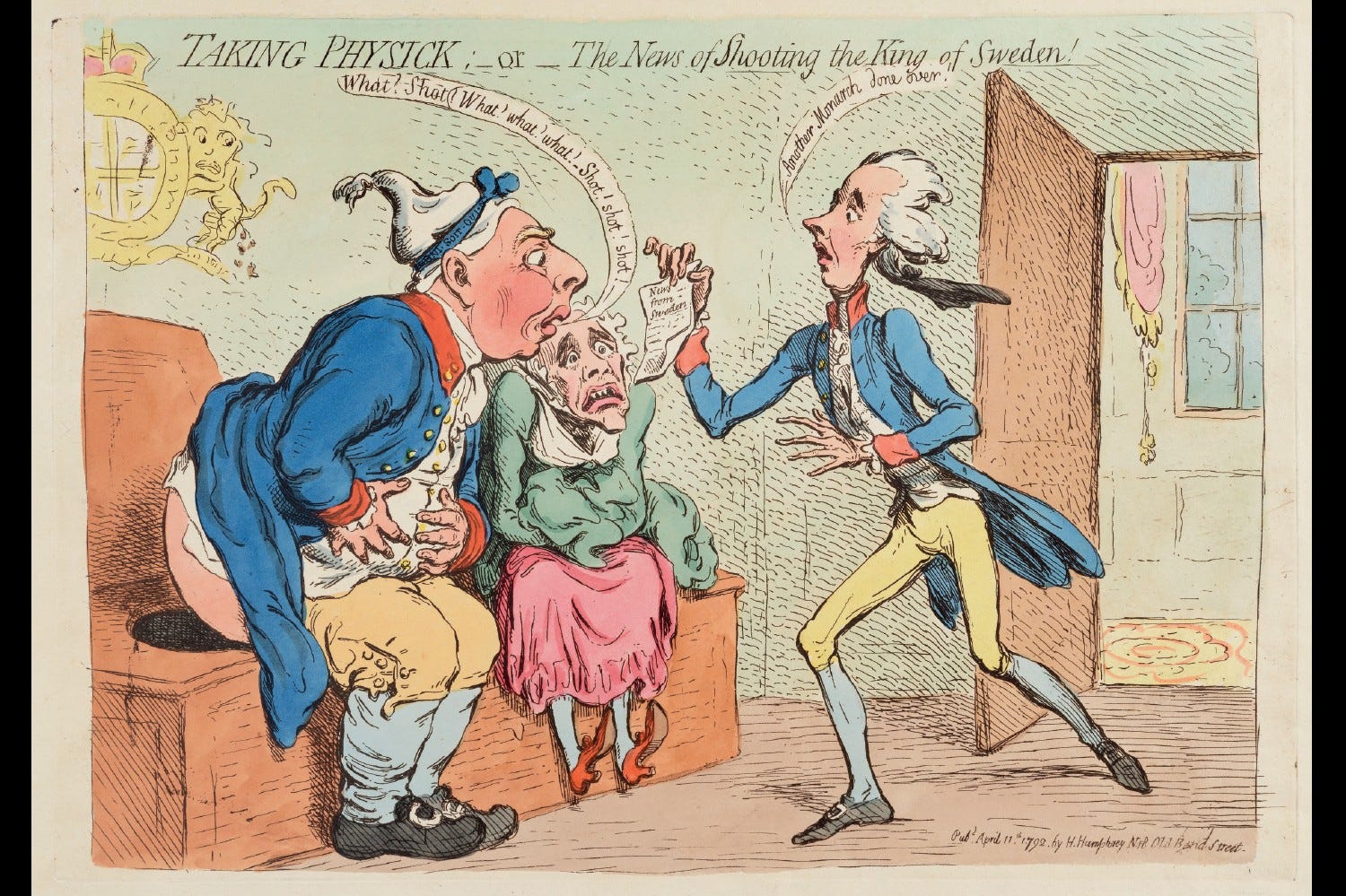
Wilkes was not the only individual against whom the king considered criminal charges. James Gillray was a satirist and printmaker. He is widely considered to be the father of the modern political cartoon. While Gillray satirized many political figures, including Napoleon Bonaparte, a frequent target of his cartoons was George III. Gillray mocked the king’s tightness with money, with a cartoon titled the “Temperance Enjoying a Frugal Meal,” in which the king is eating only an egg and the tablecloth is tucked into his collar. He also mocked the wastefulness of George’s son, the future George IV, with a cartoon entitled “A New Way to Pay the National Debt,” which showed the king and queen exiting the Treasury with gold coins falling out of their pockets. Gillray drew a caricature of the royals sitting in an outhouse, and another of the queen with her breasts exposed.
Gillray brought trouble upon himself with a caricature of Prince George after the birth of his daughter. In a print entitled “The Presentation – or – The Wise Men’s Offering,” Gillray mocked the sycophants surrounding the prince, portraying them as the Wise Men of the nativity. Although the cartoon was clearly political, Gillray was threatened with prosecution for blasphemy. Ultimately, the crown relented. Instead, one of the king’s ministers devised a more effective solution to quieting Gillray. He offered Gillray an annual pension of £200 per year if he were to cease publishing his caricatures, an offer Gillray accepted.
Lessons From George III
As Roberts makes clear, George III’s attempts to silence his critics often achieved the opposite effect, amplifying the voices of those critical of him. In a similar manner, Trump’s attacks on Kimmel and Maher have only served to point the spotlight on them. While Maher has used Trump’s attacks as grist for further humor, Kimmel has successfully portrayed himself as a victim of Trump’s misuse of his office, engendering sympathy rather than, more appropriately, boredom.
At the same time, were Trump to exhibit a thicker skin and exude calmness, the public would likely be assured by his self-confidence. As Roberts writes of George III: “Criticism and ridicule ultimately strengthened, rather than undermined the monarchy. The license with which satirists were able to treat the royal person actually helped the image of a monarch who was endearing in his display of human foibles.”
It is doubtful that the President would follow Roberts’ advice. But, the man who authored The Art of the Deal might consider an offer to pay off his critics.
 | A guest post by
|
Interesting article. I love the stories about Catch and the Improv. And was it Bush 41 who was a good sport in inviting Dana Carvey, who did such a great impersonation, to the White House?
Sure Trump could cease barraging anyone who displeases him in an ocean of unfunny vitriol. But then he wouldn't be Trump.