

There are many signposts when it becomes inescapable that one is getting old. For me, it was when I first struggled to lift the family Christmas tree, one I had handled easily in years past, off the roof of my car. For my father, it was when a young woman offered him a seat on the subway although, in his defense, he suffered from vascular Parkinson’s disease which rendered his gait increasingly wobbly.
This past week, I encountered another such signpost. I attended my 50th, or Golden, reunion at WGU. No, it was not being in the presence of hundreds of fellow geriatrics that made me feel old. As often happens at reunions, some classmates look great, others have aged poorly. Instead, it was the realization that the university, having squeezed every dollar from us, considers our reunion to be more chore than celebration. Meals that once consisted of lobster and were served in gorgeous dining halls now consist of chicken served in the freshman dining room. A Boston Pops concert is replaced by a class talent show. We have become the elderly relatives who don’t sit in the dining room with the rest of the family, but are placed in front of the television with a folding table. And our swag?

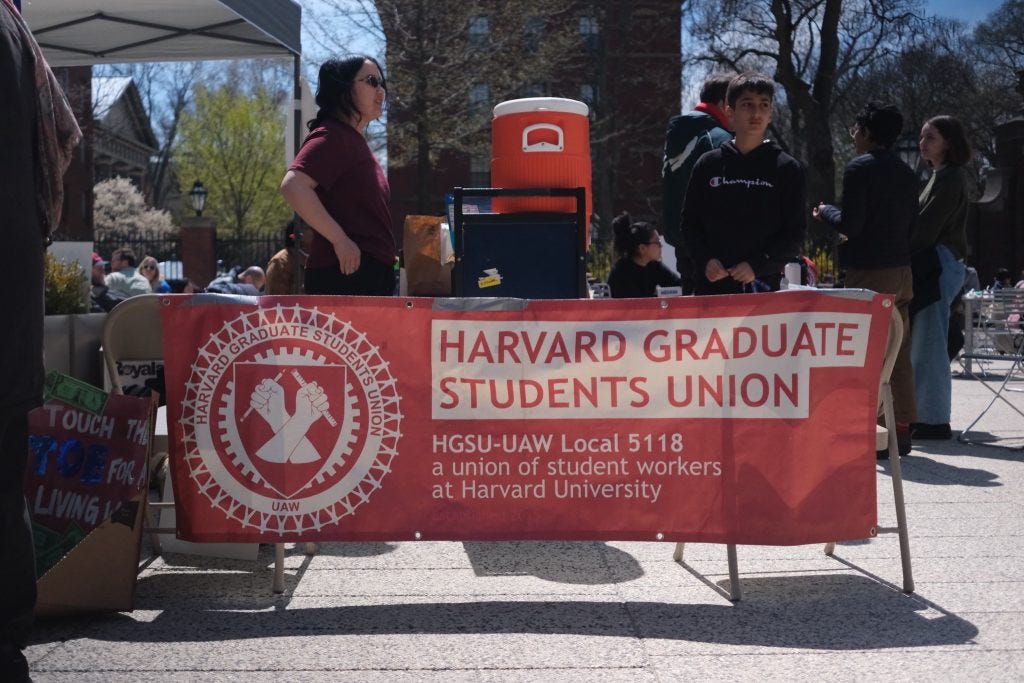
My cohorts may have aged, but they have not lost that youthful urge to embrace any cause that would be the subject of a PBS documentary. Prior to the reunion, they discovered that the Harvard Graduate Students Union (HGSU-UAW) was on strike, and the issue upon which many alums focused before arriving in Cambridge was whether our class should cross the picket line. Fortunately, the issue never presented itself. One suspects that the union shared the university’s opinion of our relevance and deemed our geriatric gathering unworthy of protest. Certainly, no pickets greeted our arrival at any activity I attended. The only protest I saw was at the registration of incoming reunions the day we were leaving, which I passed on the way to breakfast. There was no picket line, just a sad- looking graduate student holding up a sign. As he ignored my wife and me, we ignored him.
However, that does not mean that I ignored the strike entirely. One of its more striking elements (no pun intended) was that the graduate students were represented by the United Auto Workers. While this may, at first, seem an odd coupling, the UAW has been involved in student politics for some time. In fact, as recounted by Amity Shlaes in her book, Great Society, the UAW was heavily involved in the formative years of that radical student organization, Students for a Democratic Society.
Walter Reuther
Any story about the UAW’s involvement with SDS necessarily begins with Walter Reuther. Reuther was born in West Virginia to the son of a Socialist and labor activist, Valentine Reuther, who took Reuther and his brother, Victor, to meet famed union organizer Eugene Debs when the latter was in prison and they were still children.
Initially dropping out of school, Reuther secured a job at Ford, obtaining his high school diploma at night. He was fired from Ford for organizing a rally for Norman Thomas, the Socialist candidate for the presidency. Together with his brother, Reuther then traveled to the Soviet Union to teach Soviet workers to assemble Model Ts. He spent 18 months in Russia, and thereafter traveled around the world, visiting Germany, China, and Japan.
Returning to the United States, Reuther became a rising star in the UAW, playing a pivotal role in the unionization of Chrysler, General Motors, and eventually Ford. During the Ford strike, Reuther was viciously beaten by company thugs.
Reuther became president of the UAW in 1946, and then of the Congress of Industrial Organizations (CIO), the umbrella organization of which the UAW was a part. He thereafter negotiated the merger with the American Federation of Labor (AFL) to form the AFL-CIO. By the late Fifties, the UAW was the second largest union in the United States, behind only the Teamsters. George Romney, Mitt Romney’s father and the head of American Motors, termed Reuther “the most dangerous man in Detroit.” Barry Goldwater went further, declaring him “a more dangerous menace than the Sputnik or anything Soviet Russia might do in America.” On another occasion, Goldwater said “I would rather have Jimmy Hoffa stealing my money than have Walter Reuther stealing my freedom.”
Reuther’s political views were not limited to the interests of labor unions. He was an admirer of Scandinavian-style socialism who promoted numerous liberal causes, most prominently the civil rights movement led by Martin Luther King. From his earliest days as a union organizer, Reuther insisted that black workers be treated equally to whites, a position not always popular among white members competing with blacks for jobs.
The UAW contributed heavily to King’s Southern Christian Leadership Conference (SCLC) and to the broader civil rights movement. Reuther participated in King’s March on Washington, and stood on the platform for King’s “I Have a Dream” speech. Reuther also marched with King in Selma, and paid King’s bail when he was famously imprisoned in Birmingham. It is hardly surprising that Reuther would become involved with a group of leftist students.
Port Huron
The connection between the students of SDS and the UAW was not as implausible as it might appear in retrospect. SDS was just the latest incarnation of a Socialist group, the Intercollegiate Socialist Society, which was founded in 1905. Renamed the League for Industrial Democracy (LID) in 1921, to broaden its appeal, the organization maintained a student group, the Student League for Industrial Democracy. During the fifties, SLID was funded by the UAW but remained a largely moribund entity.
In 1962, Reuther and his brother, Victor, decided to take SLID national, infusing it with thousands of dollars in cash, and renaming the organization, Students for a Democratic Society. There was a personal connection as well. A top SDS deputy, Sharon Jeffrey, was the daughter of a high-ranking UAW official, Midred Jeffrey.
It was Mildred Jeffrey who provided the locale for SDS’s first convention, a camp in Port Huron, Michigan that was owned by the UAW. Fifty-nine representatives from universities around the country attended the convention. The result was the Port Huron Statement, drafted primarily by Tom Hayden, which became the manifesto for the fledgling organization.
Reuther’s motives for funding SDS were twofold. Pragmatically, he saw college students as allies in the labor movement. According to Shlaes: “What the UAW cared about was the scale of the potential constituency that students represented. . . . Students would join workers in a great future UAW.”
Philosophically, the Port Huron Statement “aligned reassuringly with the UAW’s and Reuther’s own goals.” This was particularly so with respect to the civil rights movement: “the Port Huron Statement advanced the progress of American social democracy, in a fashion its history-averse conferees might not have intended.”
Unfortunately, the cracks between the UAW and its student allies began to appear almost immediately. “From the moment the Port Huron conference kicked off, the split between those willing to work within the great American political machine and those who wanted to work outside that machine made itself felt.” The most contentious issue involved Communism. American unions had purged their members of Communists, and their members, by law, had to sign pledges that they were not Communists. Reuther, based upon his experience in Stalinist Russia, made a clear distinction between Socialism and Communism. Repeated drafts of the Port Huron Statement nevertheless defied the union’s position, arguing that “unreasoning anticommunism has become a major social problem for those who want to construct a more democratic America.”
The student radicals also were critical of unions and their leaders, deeming them a symptom of American inequality rather than the solution. The author Michael Harrington, who came to the conference as an observer, left and lodged a complaint about the students’ proposed positions with the LID executive committee. He believed that by criticizing mainstream liberals, the SDS would marginalize itself and damage the progressive cause. He also believed that the young students did not understand how Communist movements, whether Russian or Chinese, had been corrupted from their stated goals by party functionaries.
LID reacted to the early drafts of the Port Huron Statement by locking SDS out of its office and suspending payments to the organization. The rift was temporarily smoothed over, but it was never healed.
Eventually, the Vietnam War would drive the parties further apart. SDS preferred to work outside the system which included the unions that Reuther represented becoming, like many activists in the Sixties, more radical.
The Current Alliance
One suspects that the marriage between the UAW and Harvard’s graduate students is one of convenience rather than romance. It is likely motivated more by practical concerns than ideology. Whereas the UAW at one time had 1.5 million members, by the end of 2024, it had only 355,191 members. Its membership was decimated by the move of automakers to “right-to-work” states. Of the union’s current members, approximately 100,000 are employed in academia.
At the same time, Harvard, like the American auto industry, has significantly lost its prominence atop the pecking order of American universities. Like those auto makers, it sells a product that is far more expensive than it once was, but is lower in quality.
To be sure, the union has always solicited members outside the automobile industry. Its official name is the International Union, United Automobile, Aerospace and Agricultural Implement Workers of America. Nevertheless, one suspects that it is unlikely to engage in the broad social activism that sparked its tentative collaboration with the SDS.

The SDS said in 1964: Part of the way with LBJ. All that changed by 1965. By 1969 WGU’s University Hall was run over, its Deans manhandled, etc. etc. A bad move for the radicals. Most people then were rooting for the cops who cleared out University Hall. Who is rooting for WGU?.